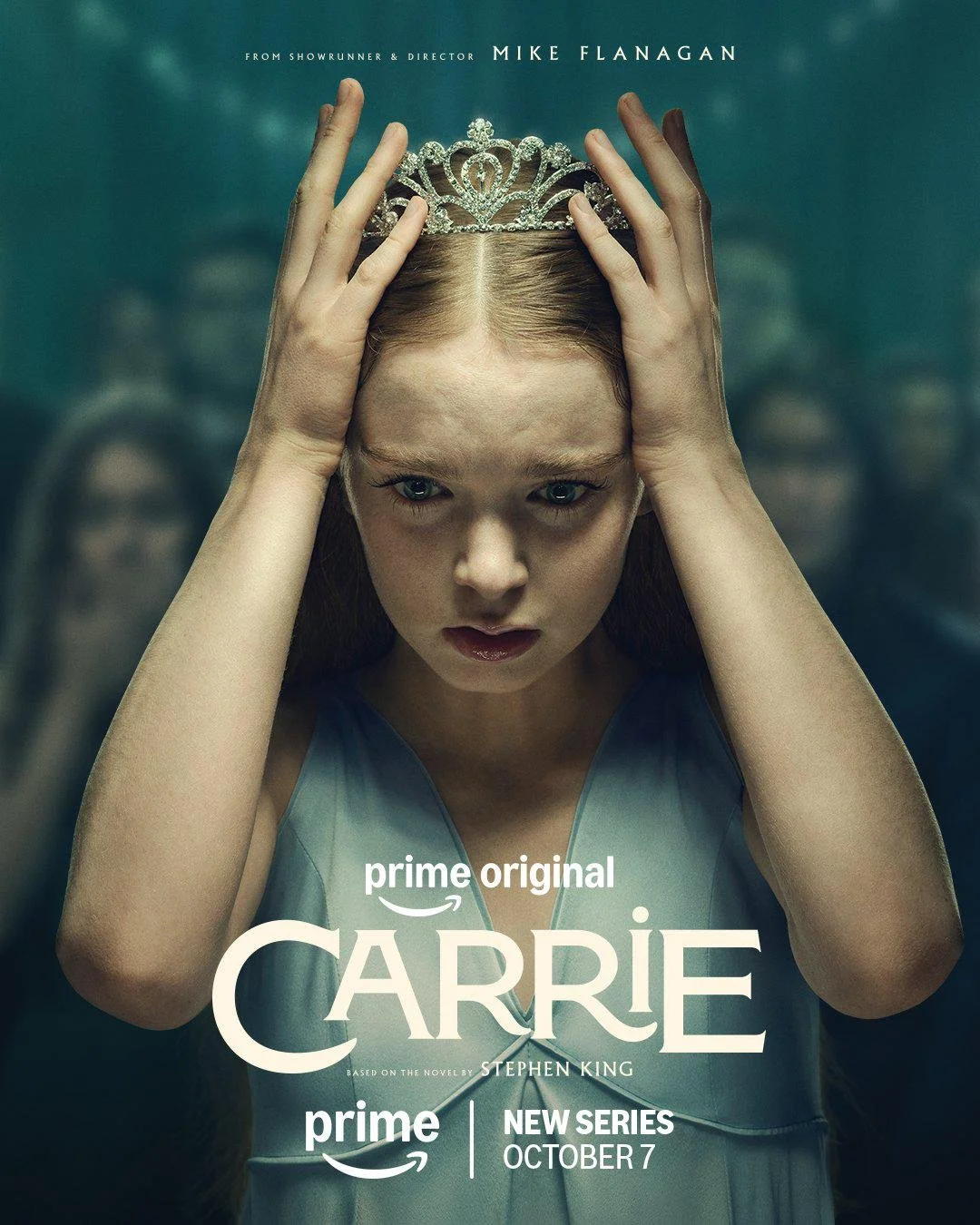
There is a concept in adaptation theory called fidelity. It comes in two flavors. Fidelity to the letter: slavish accuracy to the line and page of the source. And fidelity of spirit, where a work abandons the source’s particulars yet keeps its themes, composition, and bones intact.
Flanagan is a master of the latter. He has demonstrated it with Jackson, Henry James, Poe, King, riffing and remixing his own tales to tell, keeping the architecture of the work standing. Yet, in much of his adaptation work, there is remarkable fidelity to the letter.
For the first two-thirds of this series, Carrie is a clear love-letter to the source, updating the setting to contemporary times and revisiting well known scenes under this lens and with the additional pressures of modern society. He brings into play the terrors of school-shooter drills, social media addiction, desensitization, using each to augment the source’s examination of fundamentalism, bullying, teenage pressures and social isolation. In many places he augments the source with better presentation of the teachers, families, and the world at the periphery than was present in the original text or any of the adaptations. But Flanagan has been open that this work has already been adapted with fidelity. To the letter in the 2013 version and to the spirit by De Palma. There is no reason to simply reskin the same material again.
To this end, his Carrie adaptation becomes its own beast, with its own mythology and yet the novel’s themes, composition, and bones remain intact. There is bold departure from the text: new characters, factions and elements never approached in the source. Some characters are softened into sympathy, while others find their worst traits and actions exacerbated. It helps that no one in Flanagan’s stable, both regulars and new additions, give less than remarkable performances. Summer Howell especially: her awkwardly earnest Carrie is more sympathetic than any before her, yet never shies from the slow erosion of her innocence, or the rage building beneath. Some changes may prove divisive to King’s Constant Reader, but all of them belong.
There are subplots about the endurance test of teaching, broken homes, families, the repercussions of imperfect parenting, antisocial personalities, and fittingly enough: infidelity. All of them ring true for teenagers in the 1970s, all resonate just as hard in 2026. Some of it stings harder.
The finale diverges wildly from the source, widening the novel’s scope into something far larger, and the place we leave the survivors is not necessarily a better one. Flanagan’s vision extends beyond this single season of television. Each change positions a pawn, every addition crosses a threshold, each is a step along the Beam, bringing us closer to the clearing at the end of the path:
A field of roses.
A Dark Tower.
Ka like the wind.
Flanagan remembers the face of his father.
He shoots with his mind.